New Book
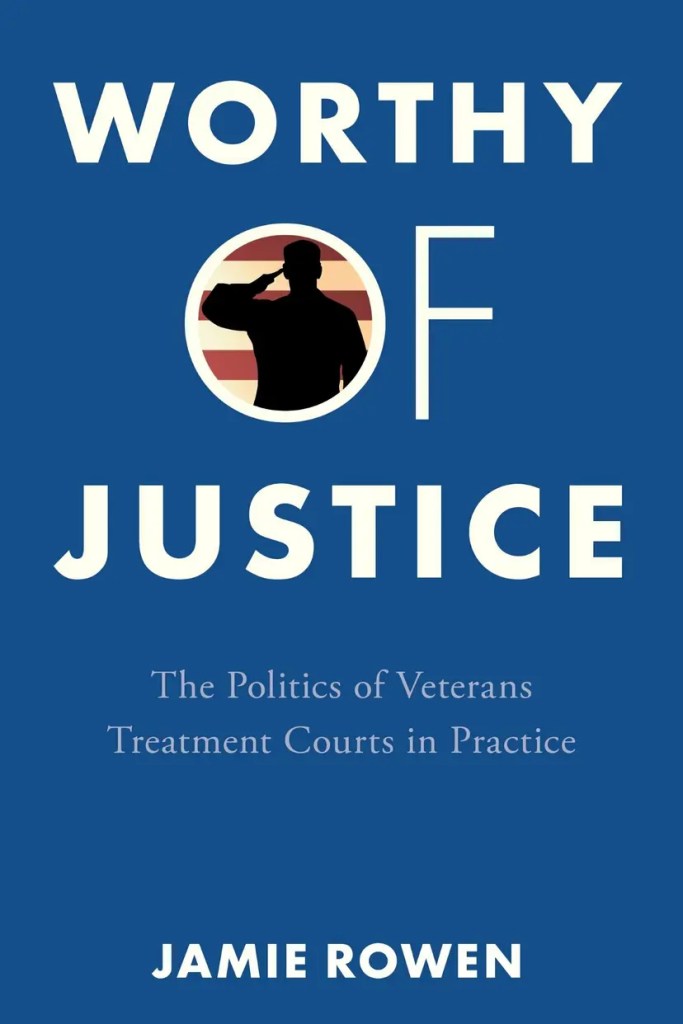
Worthy of Justice
The Politics of Veterans Treatment Courts in Practice
In Worthy of Justice, Jamie Rowen examines Veterans Treatment Courts (VTCs) as a window into the deep inequalities of the U.S. criminal legal system. Drawing on fieldwork across three courts, Rowen shows how veterans are treated as uniquely “worthy” of support because of who they are, not what they’ve done—revealing the contradictions at the heart of punishment and welfare in America.
Winner of Honorable Mention for the C. Herman Pritchett Best Book Award-Law and Courts Section of the American Political Science Association
MEDIA HIGHLIGHTS
January 15, 2026
New Books Network
Discussing Worthy of Justice and what we can learn about US democracy, criminal legal reforms, and social welfare, from the study of VTCs.
Listen here
March 3, 2026
Legal AF
Discussion on Iran invasion, domestic and international legal implications.
March 9, 2026
WWLP
Discussing Worthy of Justice and origins and practices of Veterans Treatment Courts
September 8, 2026
The Attitude
Substitute host discussing the Department of Defense and the purging of top generals with journalist and Iraq war veteran Laura Jedeed, followed by a discussion on academic freedom with former UMass Chancellor Kumble Subbaswamy.
Listen here
RECENT PUBLICATIONS
The Conversation | July 2, 2026
Military voters were at the heart of the Supreme Court’s mail‑in ballot decision
RNC v. Watson, which preserved grace periods for mail in voting, focused on ensuring that military ballots would be counted. This article discusses the history of military and veterans voting, and why generour mail in voting policies matter.
The Conversation | May 20, 2026
Veterans’ Treatment Courts Help Veterans Stay Out of Jail
Veterans Treatment Courts are uniquely able to aid veterans because of resources provided by the VA. With ongoing staffing losses and cuts to VA delivered healthcare, these programs may be less effective at their work.
Is Democracy Doomed? | May 2026
Lawyers, Veterans, and the Durability of US Democracy
This chapter, in Austin Sarat’s edited volume Is Democracy Doomed?, focuses on US lawyers and veterans as two interest groups that are challenging executive authority and reinforcing democratic institutions. These two groups deploy different repertoires of action that help illustrate leverage points to undermine democratic backsliding.
Human Rights Quarterly | May 2024
The Paradox of Diasporic Peacebuilding Amidst Violence:
Providing Reparations to Colombians Abroad
This article uses the case of Colombian migrants in the United States (U.S.) who are registered with the Colombian Unit for Victims to illustrate the tension that emerges when a home country commits to reparations for nationals in exile when violence in their home country has not ceased.
About
Jamie Rowen

Jamie Rowen is a Professor of Legal Studies at the University of Massachusetts, Amherst, and the founding director of the UMass Center for Justice, Law, and Societies. Dr. Rowen received a J.D. from Berkeley School of Law in 2009, a Ph.D. from the Jurisprudence and Social Policy Program at Berkeley School of Law in 2012, and was a doctoral fellow at the American Bar Foundation in 2012-2013. Prior to her current position at UMass, Dr. Rowen taught in the Centre for Criminology and Sociolegal Studies at the University of Toronto.
Dr. Rowen’s work examining the creation and implementation of Veterans Treatment Courts was supported by a National Science Foundation CAREER Award, and is the foundation of her new book Worthy of Justice: The Politics of Veterans Treatment Courts in Practice. Dr. Rowen’s first book, Searching for Truth in the Transitional Justice Movement (Cambridge University Press 2017), focuses on the emergence of transitional justice as an idea in international and domestic scholarship, policy making, and advocacy. Her other publications have appeared in Law and Society Review, Law and Social Inquiry, Law and Policy, Human Rights Quarterly, International Journal of Transitional Justice, and other journals and edited volumes. She is a regular contributor to The Conversation and WHNH’s “The Attitude with Arnie Arnesen,” and has appeared on WBAI (NYC Public Radio), Legal AF (Meidas Network), among other media outlets.

